Electrical Engineering and Electric Vehicle Technology

VISION

To empower persons with disabilities through inclusive, innovative, and industry-relevant education in Electrical Engineering and Electric Vehicle Technology, fostering sustainable development and independent living.

MISSION

  • To provide high-quality diploma-level education in Electrical Engineering and Electric Vehicle Technology tailored to the unique learning needs of differently abled students.
  • To integrate accessibility, sustainability, and technological innovation into the curriculum to prepare students for evolving careers in green energy and mobility sectors.
  • To promote skill development, ethical values, and lifelong learning through hands-on training, industry collaboration, and community engagement.
  • To create an inclusive environment that nurtures confidence, independence, and employability among students with disabilities.

ABOUT THE DEPARTMENT

The Diploma in Electrical Engineering and Electric Vehicle Technology was introduced from the Academic Year 2025–26 with an intake of 60 students. The programme is specially designed to empower students, including those with hearing impairment and locomotor disabilities, by equipping them with strong technical knowledge and practical skills to meet the demands of the modern technological world.

This programme aims to provide comprehensive professional training in core Electrical Engineering subjects along with emerging Electric Vehicle (EV) technologies. It integrates fundamental electrical concepts with advanced applications such as renewable energy systems, battery technology, motor control, power electronics, charging infrastructure, and EV maintenance and diagnostics.

The curriculum is structured to develop analytical thinking, problem-solving abilities, technical competence, and industry readiness. Emphasis is placed on hands-on laboratory practice, workshop training, industrial exposure, and project-based learning to ensure students gain real-world experience. Professional ethics, safety standards, sustainability practices, and innovation are key components embedded within the programme.

Electrical Engineering forms the backbone of industrial and infrastructural development, while Electric Vehicle Technology represents the future of sustainable transportation. By combining these two dynamic fields, the department prepares students to contribute effectively to power generation, transmission, automation, electric mobility, and green energy sectors.

The programme focuses on skill enhancement, specialization, and technical excellence to nurture competent diploma engineers who can adapt to rapidly evolving technologies. It also supports personality development, communication skills, and entrepreneurship to make students confident professionals.

At present, the programme has transitioned from an Outcome-Based Education (OBE) system to a Choice-Based Credit System (CBCS) to promote flexibility, goal-oriented learning, and student-centered education. This transformation ensures that learners can explore interdisciplinary opportunities and align their education with industry requirements and career aspirations.

Eligibility

Candidates who have passed SSLC (Karnataka) or its equivalent and minimum disability must be 40% in the case of Orthopedically Handicapped, 60 db for Hearing Impaired and 6/60 or 20/200 Snellen for Visually Impaired (partial) are eligible for admission.

PROGRAM OUTCOMES (POs)

PO1: Basic and discipline specific knowledge: Apply knowledge of basic mathematics, science and engineering fundamentals and engineering specialization to solve the engineering problems.
PO2: Problem analysis: Identify and analyze well-defined problems using codified standard methods.
PO3: Design/development of solutions: Design solutions for well-defined technical problems and assist with the design of systems components or processes to meet specified needs.
PO4: Engineering tools, experimentation and testing: Apply modern engineering tools and appropriate technology technique to conduct standard tests and measurements.
PO5: Engineering practices for society, sustainability and environment: Apply appropriate technology in context of society, sustainability, environment and ethical practices.
PO6: Project management: Use engineering management principles individually as a team member or a leader to manage projects and effectively communicate about well-defined engineering activities.
PO7: Life-long learning: Ability to analyze individual needs and engage in updating in the context of technological changes.
 

PROGARM SPECIFIC OUTCOMES (PSOs)

PSO1: Install, operate, maintain, and troubleshoot electrical machines, power systems, and electric vehicle components such as motors, batteries, and controllers.
PSO2: Apply knowledge of electric vehicle architecture, battery management systems (BMS), and energy storage technologies for eco-friendly mobility solutions.
PSO3: Use industry-standard tools and software for electrical system design, simulation, and diagnostics, ensuring inclusive, safe, and efficient work practices.
 

PROGRAM EDUCATIONAL OBJECTIVES (PEOs)

PEO1: Apply fundamental knowledge in electrical and electric vehicle technologies to solve real-world problems and pursue successful careers in the electrical, automotive, or allied industries.
PEO2: Demonstrate professional competence, ethical values, and inclusive practices in multidisciplinary environments, contributing effectively to society and industry.
PEO3: Adapt to technological advancements through continuous learning, up skilling, and possibly pursuing higher education in related domains.
PEO4: Exhibit leadership qualities and problem-solving skills while addressing sustainability, environmental, and energy efficiency challenges.
 

Course Outcomes

Upon successful completion of this course, students will be able to explain the fundamental concepts, architecture, components, and operating principles of Electric Vehicles and Electric Vehicle Technology. They will analyze the characteristics and performance of electric drive systems, traction motors, battery technologies, and power electronic converters used in EV applications. Students will apply their knowledge of charging systems, energy storage, battery management systems, and energy management strategies to real-time electric mobility applications. Further, they will evaluate safety standards, maintenance procedures, fault diagnosis and troubleshooting techniques to ensure efficient and reliable operation of Electric Vehicle systems.

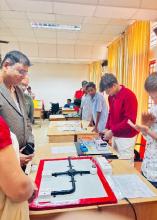
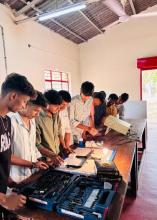
The Department of Electrical Engineering and Electric Vehicle Technology provides modern infrastructure with well-equipped smart classrooms, advanced laboratories, workshop facilities, computer labs, and Wi-Fi connectivity, all accessible to differently abled students. The department is supported by qualified and dedicated faculty committed to delivering quality technical education through sign language/total communication, visual presentations, and hands-on training.

Specialized laboratories such as Electrical Machines, Power Electronics, EV Technology, Renewable Energy, and Battery Maintenance Labs provide practical exposure. Modern computers with simulation software enhance learning in circuit design, motor control, and electric vehicle systems, ensuring industry-ready training.


Additional facilities for the Differently Abled

The department has wheelchair accessible building with corridors and supporting railings.
• The classrooms, Studios, laboratories and toilets(with Grab Bars) are all wheelchair accessible.
• The faculty and the supporting staff are all well versed in communicating with hearing impaired students.
• Sign language interpreter services are provided for guest lectures and other seminars.
• Psychology counseling is provided for the students who are in need.
• The needy orthopedically disabled students are provided with assistance in the laboratories to conduct experiments.
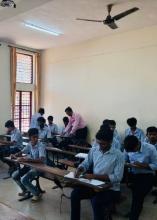
• Printed notes for reference , Additional 20 minutes per hour and Scribe facilities are provided during the examinations.
 

Laboratories used to train the students

1

Electrical Wiring System & Practice     

2

Concepts of Electrical Circuits

3

Generation, Transmission and Distribution

4

Power Electronics

5

Switch gear and Protection       

6

Analog and Digital Electronics

7

Electrical Motors & Drives

8

Transformers and Generators

9

Fundamentals of Electrical Vehicle Technology     

10

Automobile Chassis and Transmission

11

Electric Utility Engineering 

12

Solar energy

13

Internet of Things(IoT)      


Technical Staff

1
Likith V
Diploma in  Electrical and Electronics
Instructor

Vidya S K
Designation: Programme Coordinator
Educational Qualification B.E in Electrical and Electronics
Area of Specialization: Power Electronics and Industrial Drives
E-Mail: vidyasharaff@gmail.com

Vidya S K
Sahana V
Designation: Lecturer
Educational Qualification B.E in Electrical and Electronics
Area of Specialization: Electrical machines and Protection
E-Mail: v.sahana25@gmail.com

Sahana V
Curriculum for Electrical Engineering and Electric Vehicle Technology